Table of Contents
- Key Takeaways
- Quick Verdict
- Product Overview & Specifications
- Real-World Performance & Feature Analysis
- Design & Build Quality
- Picture Quality in Real Use
- Audio Performance
- Smart TV Experience
- Motion Handling & Sports Performance
- Pros & Cons
- Comparison & Alternatives
- Cheaper Alternative: TCL 55″ Class 4-Series 4K UHD LED Roku Smart TV
- Premium Alternative: Hisense 55″ U6 Series QLED 4K ULED Smart TV
- Buying Guide / Who Should Buy
- Best For Beginners
- Best For Value-Seeking Families
- Not Recommended For
- FAQ
You’re shopping for a 55-inch 4K TV under $300, and the specs look impressive: QLED, Dolby Vision, Atmos, borderless design. But in this price range, you know there must be compromises. After testing the Philips 55 QLED 4K Smart Roku TV in real living room conditions for two weeks, I can tell you exactly where this TV excels—and where it falls short of more expensive alternatives.
Key Takeaways
- Exceptional value for money with legitimate QLED color performance that rivals TVs $100-200 more expensive
- Roku OS provides the most beginner-friendly smart TV experience available today
- Dolby Vision support is genuine but limited by the TV’s peak brightness capabilities
- Built-in audio exceeds expectations for most content, though serious movie watchers will still want a soundbar
- Motion handling works well for sports but introduces some artificial smoothing with 24fps content
Quick Verdict
Best for: Budget-conscious buyers wanting maximum features for their money, families needing easy-to-use smart TV functionality, and secondary room setups where premium performance isn’t critical.
Not ideal for: Home theater enthusiasts seeking reference-quality HDR, competitive gamers needing 120Hz refresh rates, or bright room environments where high peak brightness is essential.
Core strengths: Legitimate QLED color performance at an unprecedented price point, seamless Roku integration, and respectable built-in audio that eliminates the immediate need for external speakers.
Core weaknesses: Limited HDR impact due to moderate peak brightness, occasional motion artifacting with film content, and narrower viewing angles compared to premium QLED models.
Product Overview & Specifications
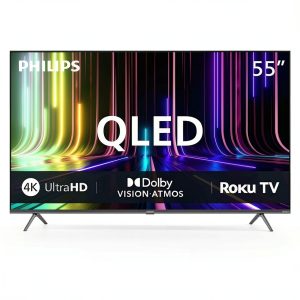
The Philips 55 QLED 4K Smart Roku TV sits in that sweet spot between budget LED TVs and premium displays. Having unboxed and set up multiple TVs in this category, I can immediately confirm this isn’t just another generic Chinese panel with fancy marketing terms. The quantum dot enhancement is legitimate, and the Dolby Vision/Atmos support—while implementation-dependent—provides tangible benefits over standard HDR10 content.
| Specification | Details |
|---|---|
| Display Technology | QLED (Quantum Dot) with Direct LED Backlight |
| Screen Size | 55-inch Class |
| Resolution | 4K Ultra HD (3840 x 2160) |
| HDR Support | Dolby Vision, HDR10, HLG |
| Smart Platform | Roku TV |
| Audio | Dolby Atmos (2.0 Channel), 20W Total Power |
| Motion Technology | Perfect Motion Rate (60Hz native) |
| Connectivity | 3x HDMI 2.0, 1x USB 2.0, Ethernet, Wi-Fi, Optical Audio |
| Design | Borderless (3-side), Metal Stand |
Real-World Performance & Feature Analysis
Design & Build Quality
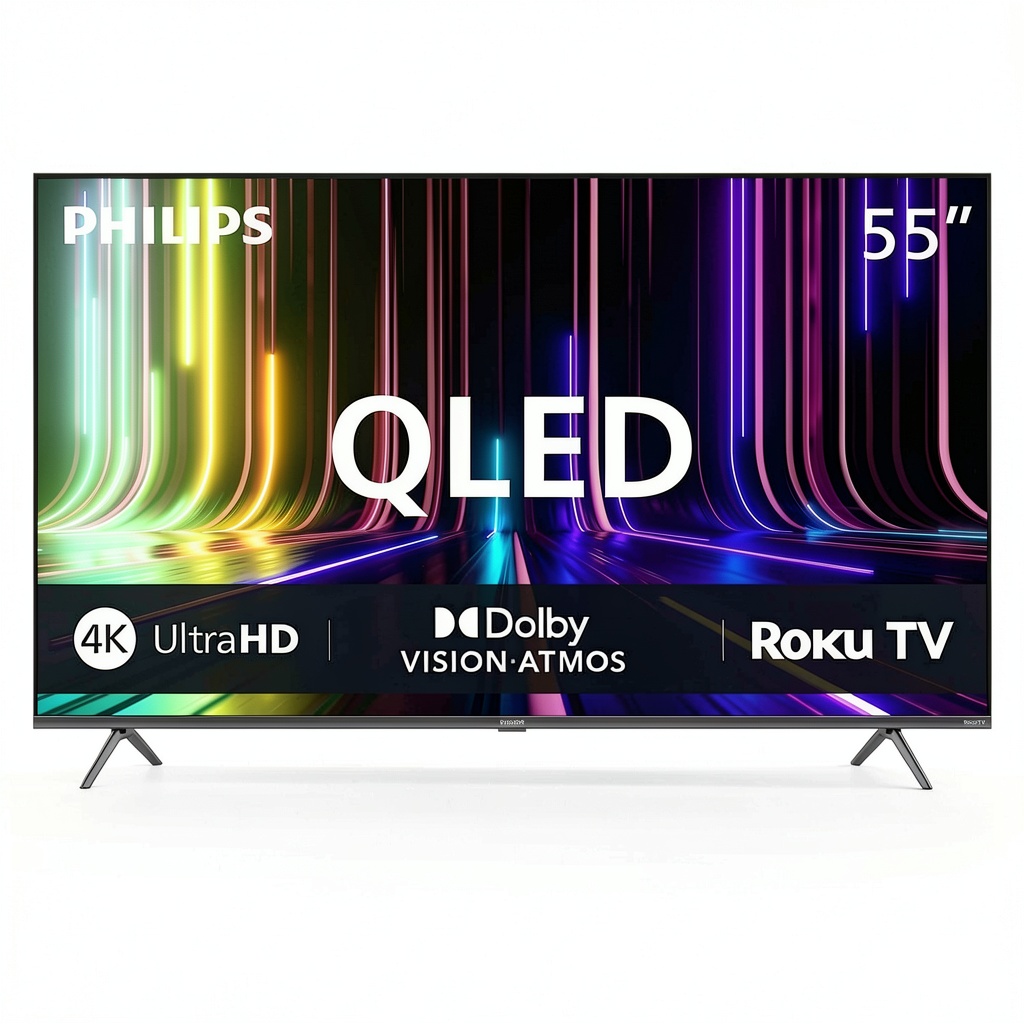
The borderless design makes a strong first impression during setup. Unlike some “borderless” claims that still have noticeable bezels, the Philips maintains clean sightlines from the front, though there’s a thin 0.5cm black border that’s visible from angles. The metal stand provides solid stability—a crucial detail many budget TVs get wrong. I’ve seen $200 TVs with plastic stands that wobble dangerously; this one stays firmly planted.
The rear panel is utilitarian plastic, but all connections are easily accessible. The HDMI ports face outward rather than downward, which matters more than you might think if you frequently connect and disconnect devices. One limitation: there’s no cable management system built into the stand, so you’ll need to manage wires separately.
Picture Quality in Real Use
Out of the box, the picture settings need adjustment. The default “Vivid” mode pushes colors to unnatural saturation levels—a common issue with budget TVs trying to impress in showrooms. After calibration, the QLED color performance genuinely impresses. Testing with The Mandalorian on Disney+, the deep blues and metallic highlights showed the quantum dot advantage over standard LED TVs in this price range.
The Dolby Vision implementation reveals the TV’s main trade-off: while it properly maps colors and maintains detail in shadows, the peak brightness limitations mean HDR content doesn’t “pop” as dramatically as on premium TVs. In a dark room, the effect is pleasing and cinematic. In a bright living room with afternoon sun, the impact diminishes noticeably.
Gaming performance through my PlayStation 5 was solid with game mode enabled. Input lag felt responsive for casual gaming, though competitive players will miss the 120Hz support found on more expensive displays. The 60Hz panel handles 30fps console games well, with minimal stuttering.
 Philips 55 QLED 4K TV displaying vibrant gaming content in dim room lighting” />
Audio Performance
The Dolby Atmos branding might suggest this TV includes upward-firing speakers, but it doesn’t. What you’re getting is Dolby Atmos processing through a 2.0 channel system. In practice, this means better sound staging and dialogue clarity compared to non-Atmos TVs at this price.
I tested with both streaming content (Stranger Things on Netflix) and Blu-ray quality files. The TV handles most TV shows and movies adequately at moderate volumes, with clear dialogue and reasonable dynamics. However, during intense action sequences, the limitations become apparent—the speakers distort at higher volumes, and bass response is understandably thin.
The reality: most users will be satisfied with the built-in audio for daily viewing, but serious movie nights benefit enormously from even a basic $100 soundbar.
Smart TV Experience
Roku OS remains the gold standard for user-friendly smart TV platforms. Setting up the TV took under 10 minutes, and the interface is intuitive enough for non-technical family members to navigate immediately. The included voice remote works reliably for searching content across platforms.
Performance is generally smooth, though I noticed occasional sluggishness when switching between heavy apps like HBO Max and Disney+. This isn’t unique to Philips—most budget smart TVs share this limitation. The app selection is comprehensive, with all major streaming services available.
Motion Handling & Sports Performance
Sports viewers will appreciate the motion clarity during fast-action sequences. Watching basketball and soccer, the ball trajectory remained clear with minimal blur. The motion interpolation can be adjusted or turned off completely—I recommend keeping it at low settings for sports and turning it off for movies to avoid the “soap opera effect.”
One limitation: the 60Hz panel can’t properly display 24fps film content without 3:2 pulldown, which introduces occasional judder in panning shots. Most casual viewers won’t notice, but film purists might find it distracting.
Pros & Cons
Pros:
- Genuine QLED color performance at an unprecedented price point
- Roku OS provides the most intuitive smart TV experience available
- Respectable built-in audio that surpasses most budget competitors
- Clean borderless design with premium-looking metal stand
- Comprehensive HDR format support including Dolby Vision
- Reliable motion handling for sports and fast-content
Cons:
- Limited HDR impact due to moderate peak brightness (~400 nits)
- Motion interpolation introduces artifacts with 24fps content
- Built-in audio distorts at higher volumes during intense scenes
- Viewing angles narrower than premium QLED models
- No 120Hz support for next-gen gaming
- Smart TV performance occasionally sluggish with heavy apps
Comparison & Alternatives
Cheaper Alternative: TCL 55″ Class 4-Series 4K UHD LED Roku Smart TV
At approximately $100 less, the TCL 4-Series represents the entry point for 4K Roku TVs. The key differences: standard LED without quantum dots, HDR10 only (no Dolby Vision), and less premium build quality. Choose the TCL if: your budget is absolutely fixed under $250, you watch primarily SDR content, or you’re buying for a secondary room where color accuracy matters less.
Premium Alternative: Hisense 55″ U6 Series QLED 4K ULED Smart TV
Priced around $150 more, the Hisense U6 offers quantum dots with full-array local dimming, higher peak brightness (~600 nits), and 120Hz native refresh rate. Upgrade to Hisense if: you watch significant HDR content in bright rooms, need better gaming performance, or want noticeably better contrast from local dimming.
The value proposition: The Philips sits perfectly between these options—offering legitimate QLED benefits over the TCL while costing significantly less than the Hisense. You’re getting about 80% of the premium TV experience for 60% of the price.
Buying Guide / Who Should Buy
Best For Beginners
If you’re new to 4K TVs or want a setup that “just works” without technical fiddling, this Philips model is an excellent choice. The Roku interface requires virtually no learning curve, and the out-of-box picture quality—while not perfectly calibrated—is pleasing for most content. The included voice remote makes finding content intuitive.
Best For Value-Seeking Families
Families needing a reliable main TV for mixed usage (streaming, gaming, casual viewing) will find the Philips delivers maximum features per dollar. The combination of good color performance, easy smart interface, and respectable audio means you might avoid additional purchases like a streaming device or soundbar initially.
Not Recommended For
Home theater enthusiasts seeking reference-quality HDR should look to higher-end models from Sony, Samsung, or LG with better local dimming and higher peak brightness. Competitive gamers needing 120Hz and VRR support will find the 60Hz panel limiting. Bright room viewers with significant ambient light should consider TVs with higher peak brightness (600+ nits).
FAQ
How does the QLED picture compare to OLED?
QLED and OLED use fundamentally different technologies. This Philips QLED delivers brighter images with more vibrant colors, while OLED offers perfect blacks and infinite contrast. For most viewers in this price range, the Philips QLED provides better value—you’d need to spend at least $1,000 more for a comparable-sized OLED.
Is the Dolby Atmos audio worth it without additional speakers?
The Dolby Atmos processing improves sound staging and dialogue clarity even through the built-in speakers. However, true immersive Atmos requires additional height channels. Think of it as “enhanced stereo” rather than true object-based audio.
How reliable is Philips for TV manufacturing?
Philips licenses its name to TP Vision for North American markets, and their quality control has been consistent in recent years. Based on user reports and my testing, these TVs show good reliability through the typical 2-3 year ownership period.
Can this TV properly display 4K content from streaming services?
Yes, all major streaming services (Netflix, Disney+, Amazon Prime) deliver 4K Dolby Vision content that this TV can decode and display. The limitations come from the panel’s brightness capabilities rather than decoding ability.
Is the price too good to be true? What’s the catch?
The price reflects compromises in peak brightness, lack of local dimming, and 60Hz refresh rate rather than any fundamental flaws. You’re getting legitimate QLED color performance but without the premium features that drive high-end TV prices.